Skip to content
rbsolutions / operational software

The spreadsheet became the business. We replace it.

We turn complex, manual workflows into production software your team can actually run every day.

Freight and cargo. Property operations. Customs paperwork. Bookings and billing — anywhere the real process lives in spreadsheets, email and someone's memory.

rbsolutions.works · hello@rbsolutions.works
the problem

The work gets done. It just passes through too many hands.

  • Spreadsheets
  • Email
  • Chat
  • Paper logbooks
  • Manual reconciliation
  • Re-keying
re-keycopyre-keyretypemanifest_FINAL_v3.xlsx#REF!??SpreadsheetsFwd: RE: RE: updated listsee attached (latest?)EmailHas box 214 left yet?Let me check the logbook…ChatPaper
A freight forwarder, two countries

Package details emailed between offices, then re-keyed by hand and tracked on paper.

A 42-unit building, two business models

Rooms, leases and submetered utility bills run from spreadsheets and a logbook.

A customs filer

The same declarations re-typed every week, onto a form that must print exactly right.

These are the real operations behind the systems in this deck. Each ran on re-keyed data, work assembled by hand, and answers that lived in someone's inbox.

the cost of the workaround

Every manual handoff creates cost.

SpreadsheetEmailRe-keyVerifyReconcileReportattached,not sharedtypedagainerrorsentercheckedtwiceassembledby hand

Time goes to administration

Every handoff is somebody's afternoon.

Errors are hard to trace

When data is copied, nobody knows which copy is right.

Managers can't see now

The report describes last week, assembled by hand.

Customers wait for answers

“Where is it?” becomes a phone call.

Knowledge sits in people

The process works because one person remembers how.

When something went missing, reconstructing its history meant phone calls between offices and a search through inboxes.
— from the freight case study
what we build

We turn your costliest workflow into production software.

Operations

  • Workflow & approvals
    freight custody · payment validation
  • Multi-site platforms
    two offices, one system
  • Role-based access
    enforced in the database
  • Scheduling & dispatch
    bookings · driver dispatch
  • Status & tracking
    package-level custody

Money

  • Billing & invoicing
    rent + submetered utilities
  • Payments
    e-wallet & transfer, validated
  • Receivables
    from the same records
  • Reconciliation
    payments settled to invoices

Documents

  • Document automation
    saved, reopened, reprinted
  • Government & customs forms
    customs declarations
  • Print & PDF workflows
    millimetre-accurate A4
  • Structured records
    every filing is data

Intelligence

  • Deterministic business rules
    status from real scans
  • Automated QA
    tests gate every release
  • Operational reports
    accounting & receipts
  • AI-assisted workflows
    our approach — not yet in production

running in a production system todayapproach we design for

proof

Built for real operations.

Systems in productionRunning real operations today
3
Countries connected by one production systemFreight & logistics
2
Schema changes shipped liveFreight & logistics
80+
Package states modelledFreight & logistics
20
Units under managementProperty & hospitality
42
Staff roles, each scopedProperty & hospitality
5

building nextAn operating system for court-sports venues (Pre-MVP)

case 1 of 3/In production
Singapore–Philippines freight forwarder

From emailed spreadsheets to a cargo operating system.

Consolidated sea freight, Singapore ↔ Philippines. Two offices, one record.

  1. Registered
  2. At SG office
  3. In container
  4. Unloaded (Manila)
  5. Sorted
  6. Out for delivery
  7. Delivered
A package's journey — status names taken from the running system, simplified
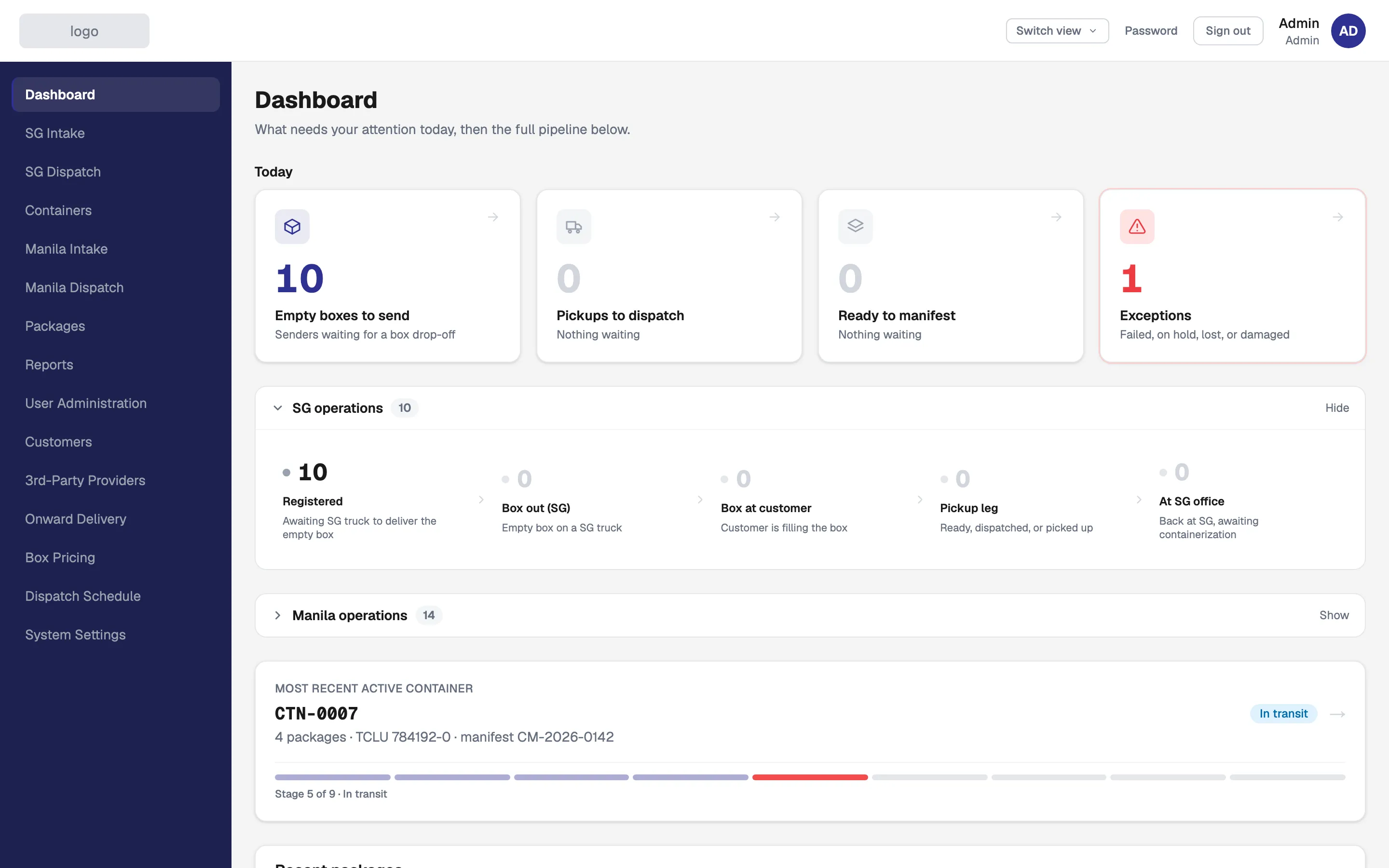
Operations dashboard — every package's current custody stage

Problem

  • Package details emailed from the Singapore counter to the Manila office
  • Re-keyed by hand on arrival — errors land in the one field that matters: whose box is this
  • Movement tracked on paper, so it could not be queried or audited
  • A missing package meant phone calls between offices and a search through inboxes

System

  • One shared system across both countries, with the package as the unit of truth
  • QR scanning from intake — staff scan instead of type
  • A seven-stage custody flow, with the exceptions modelled: lost, damaged, on hold, failed attempt
  • Driver dispatch, a public booking flow, and mobile tracking for customers
  • Photographic proof of delivery

Evidence

2
Countries on one system
7
Custody stages (happy path)
20
Package states incl. exceptions
80+
Schema migrations shipped

What changed

  • Nothing is re-keyed between offices
  • Where a package is, and where it has been, is a query — not a phone call
  • Customers see their own shipment; delivery is evidenced
Read the full case study →
case 2 of 3/In production
Philippine student-housing operator

One building. Two business models. One system.

Nightly rooms and year-long leases with utility submeters, under one roof.

42
units under management
5
distinct staff roles
Nightly + monthly lease
business models on one platform
  1. Reservation
  2. Lease
  3. Invoice (rent + submeter)
  4. Payment validated
  5. Receipt & reports
The chain that used to be re-entered at every step
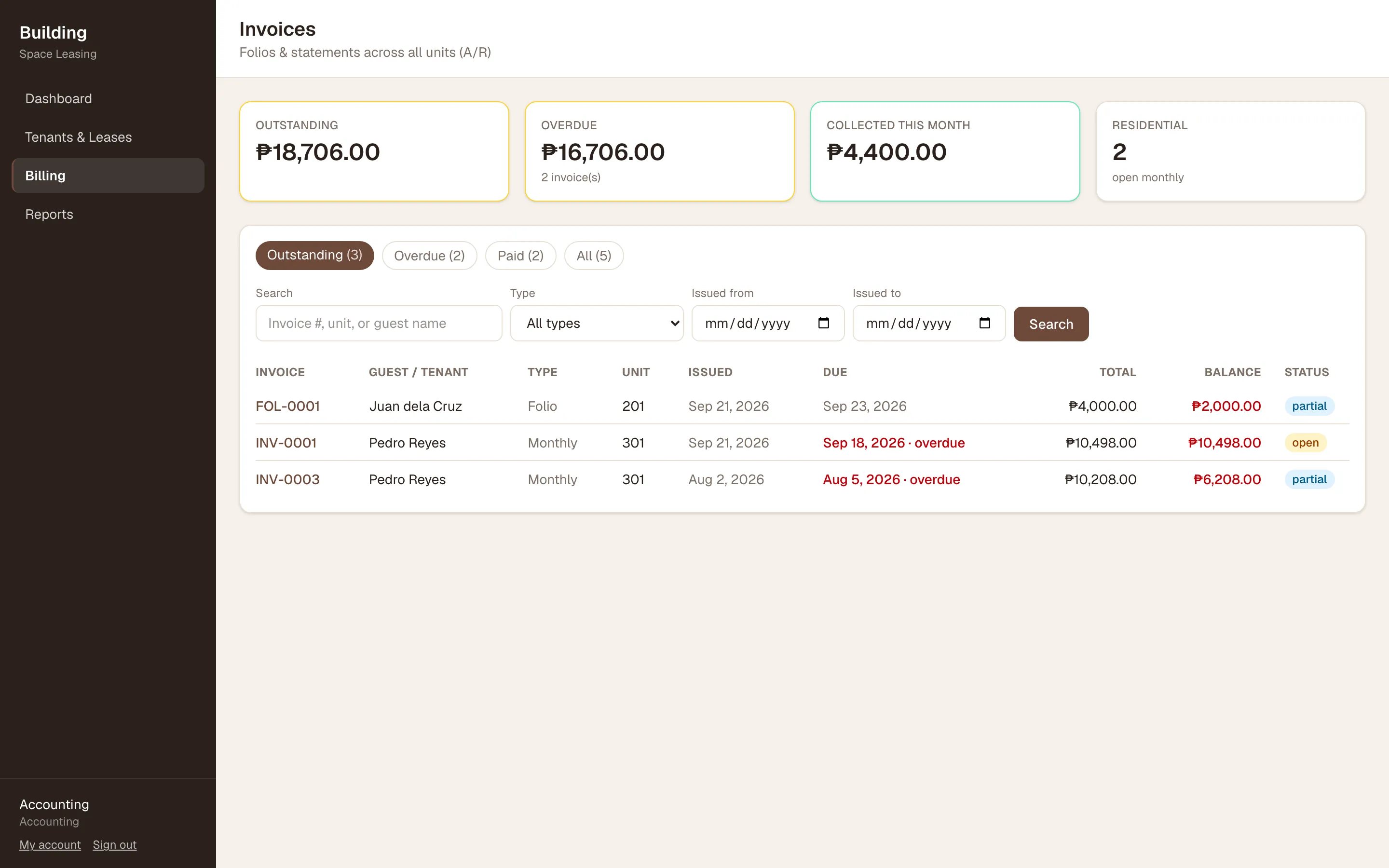
Invoices across nightly folios and monthly leases, with balances

Problem

  • Run on spreadsheets and a logbook
  • Which rooms are free, who owes money, and what each tenant used lived in different places
  • Submetered utility bills worked out by hand from meter readings, every month

System

  • Reservations that become leases that become invoices — entered once
  • Submeter readings carried straight into each invoice
  • E-wallet and transfer payments, validated by staff against the uploaded receipt

What changed

  • Front desk, housekeeping and the books are the same system
  • Availability is live, not reconstructed
  • Invoices, receipts and reports come from recorded activity, not hand assembly
Read the full case study →
case 3 of 3/In production
RB Solutions venture

When correctness matters, the software has to be deterministic.

Customs declarations laid out to the millimetre against the official form.

Rebuilt in HTML/CSS, sized in mm to A4
print fidelity
Row-level security, per user
record isolation
Reopen, edit, reprint
refiling a saved form
  1. Form definition
  2. Fill
  3. Save
  4. Reopen & amend
  5. Print to A4
Every filing after the first starts from saved data
DECLARATIONConsignorConsigneeReference no.DatePortDescription of goodsGross weightDeclared value210 mm14 mm30 mm… 297 mmPositioned in millimetres, not pixels

Problem

  • The same declarations re-typed by hand, week after week
  • Transcription errors in documents that carry legal weight
  • Scan-and-overlay tools print soft and drift with printer margins

System

  • Each form rebuilt in HTML and CSS, positioned in millimetres against A4
  • Filings saved, reopened, amended and reprinted — not retyped
  • Printing through the browser: no print server, Save as PDF included

What changed

  • Next week's filing starts from this week's, not from a blank form
  • The same layout is generated every time, through the browser
Read the full case study →
why our systems last

Built to change without breaking.

On our freight platform, every release passes an automated gate before it reaches the team using it.

ChangeUnit testseach business rule,on its own✕Database testspermissions & datarules, where they live✕Workflow testsa browser clicksreal journeys✕Coverage checkfails the buildif coverage slips✕ProductionAny failure sends the change back to be fixed — it never reaches production.
The freight platform has taken 80+ schema changes while in daily production use, with every release gated by its test suite.
On the property platform, the tests check not only that accounting can open the reports — but that housekeeping cannot.

Features change. Business rules change. Your software needs to change with them.

how we use ai

AI where it helps. Code where correctness matters.

  1. AI

    Understands intent

    Reads what the customer is asking, in their own words.

  2. Software

    Applies business rules

    Finds the rates, rules and records that apply.

  3. Deterministic code

    Calculates what must be right

    Prices, dates and amounts come from code, every time.

example — a freight quote
  1. CustomerHow much will it cost to ship this box to Manila?
  2. AIUnderstands this is a quote request for one box, Singapore to Manila.
  3. deterministic — the model can't change this
    SystemRetrieves the current pricing rules for that route and box size.
    CodeCalculates the price.
  4. AIExplains the result in plain language — without changing the number.

The model should never invent a business-critical value.

The production systems in this deck run on deterministic code. This is the architecture we apply when AI is added to an operational system.

how we work

Start with the workflow costing you the most.

  1. 01

    Discover

    Find the workflow costing the most time, errors or margin.

  2. 02

    Prove

    Map it, and agree what “working” means before building.

  3. 03

    Build

    The smallest production-worthy system around that workflow.

  4. 04

    Launch

    Into the hands of the people who actually do the work.

  5. 05

    Expand

    Once the first workflow works, replace the next one.

Show us the workflow you hate doing.

Bring one process that still runs through spreadsheets, email, chat, paper or manual reconciliation. We'll map it, identify what should be automated, and tell you what it would take to turn it into production software.

Start a conversation →hello@rbsolutions.works